
GNSS-Denied Resilience Testing & Navigation
SoliosAI supports engineering teams with GNSS-denied resilience testing, EW resilience assessment, jamming and spoofing scenario review, degraded navigation analysis, and performance evidence for autonomous navigation systems operating in complex environments.
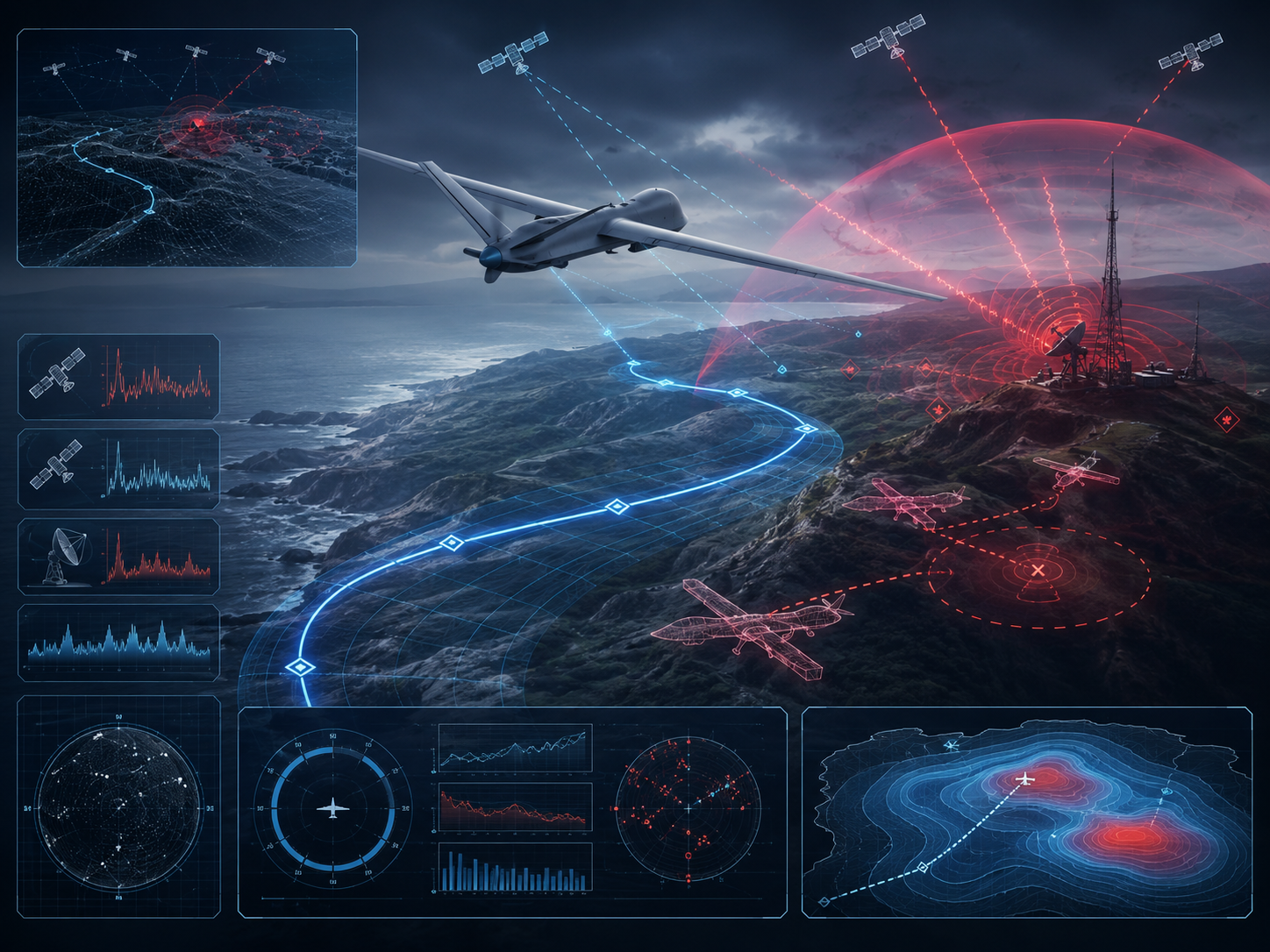
GNSS-denied resilience testing helps engineering teams understand how an autonomous navigation system behaves when positioning becomes degraded, denied, spoofed, jammed, or uncertain. SoliosAI can support GNSS outage assessment, electronic warfare scenario review, navigation drift analysis, sensor uncertainty assessment, degraded-condition simulation, and resilience evidence preparation for technical reviews, design decisions, and operational risk discussions.
Assess Navigation Behaviour When GNSS Is Degraded or Denied
Autonomous systems can appear stable under normal positioning conditions but behave differently when GNSS becomes unreliable, jammed, spoofed, denied, or partially degraded. SoliosAI helps teams explore these GNSS-Denied Resilience Testing navigation behaviours through controlled assessment so uncertainty growth, drift, recovery behaviour, and resilience limitations can be identified earlier.
Useful for:
- GNSS outage and degradation scenarios
- Jamming and spoofing response assessment
- Sensor dropout and uncertainty growth
- Navigation resilience evidence for technical reviews
What This Capability Supports
GNSS Degradation and outage Simulation
Explore how navigation performance changes when positioning quality is reduced, interrupted, delayed, biased, or unavailable. Review navigation behaviour during GNSS loss, partial degradation, signal dropout, or intermittent positioning availability.
Spoofing & Jamming Scenario Analysis
Assess how navigation systems may respond to interference, spoofed signals, contested environments, and electronic warfare style conditions.
Navigation Drift & Recovery
Review drift growth, recovery behaviour, position uncertainty, route deviation, and mission impact during degraded navigation.
Sensor-Fusion Resilience
Evaluate how IMU, GNSS, visual, radar, or other sensor inputs influence system confidence, drift, and fallback behaviour.
Risk & Evidence Reporting
Convert degraded-navigation behaviour into clear metrics, plots, scenario summaries, and technical evidence for design reviews.
Example Assessment Scenarios
SoliosAI can support GNSS-denied and EW resilience testing across scenarios such as:
- GNSS outage and partial signal loss assessment
- Jamming scenario review
- Spoofing and false-position behaviour analysis
- Degraded positioning and navigation drift assessment
- Sensor dropout and uncertainty growth review
- Route deviation and mission-impact analysis
- Resilience comparison between operating scenarios
- Replay-style review of navigation behaviour and recovery
Depending on the project scope, outputs may include:
- Navigation resilience findings
- GNSS-denied scenario summaries
- Drift, error, and uncertainty plots
- Route deviation and mission-impact notes
- Jamming or spoofing scenario evidence
- Sensor uncertainty and degradation observations
- Risk-focused findings and practical recommendations
- Evidence suitable for technical review discussions
Explore related SoliosAI capabilities including UAV mission trajectory simulation, Kalman filter and sensor fusion diagnostics, and verification and validation support.
Who This Is For
This capability is suitable for autonomy teams, UAV and robotics integrators, sensor-fusion developers, mining technology groups, maritime autonomy teams, research organisations, and engineering decision-makers who need evidence of how navigation systems behave when GNSS or other positioning inputs become degraded, denied, uncertain, or unreliable.
Need to Assess Navigation Resilience Before the Next Review?
Discuss your GNSS-denied navigation, jamming, spoofing, degraded positioning, or EW resilience testing challenge with SoliosAI.