
GNSS-Denied Navigation Resilience Assessment
SoliosAI supports engineering teams with GNSS-denied navigation resilience assessment for autonomous systems operating under degraded, denied, biased, spoofing-style, jamming-style, or uncertain navigation conditions. The assessment can use client-approved system information, simulation outputs, logs, plots, screenshots, or sanitised data to identify navigation risk and practical next steps.
Assess Navigation Resilience When GNSS Cannot Be Trusted
Autonomous systems often depend on GNSS for positioning, timing, route-following, and navigation confidence. When GNSS becomes degraded, unavailable, biased, spoofed, jammed, or uncertain, small navigation issues can quickly become mission, safety, performance, or decision-making risks. SoliosAI helps teams assess how navigation behaviour changes under degraded positioning conditions and identify practical next steps for resilience improvement.
Useful for:
- GNSS outage and degradation scenarios
- Navigation drift and uncertainty growth
- Spoofing-style bias and jamming-style disruption
- Sensor dropout and fallback behaviour
- Technical recommendations for resilience improvement
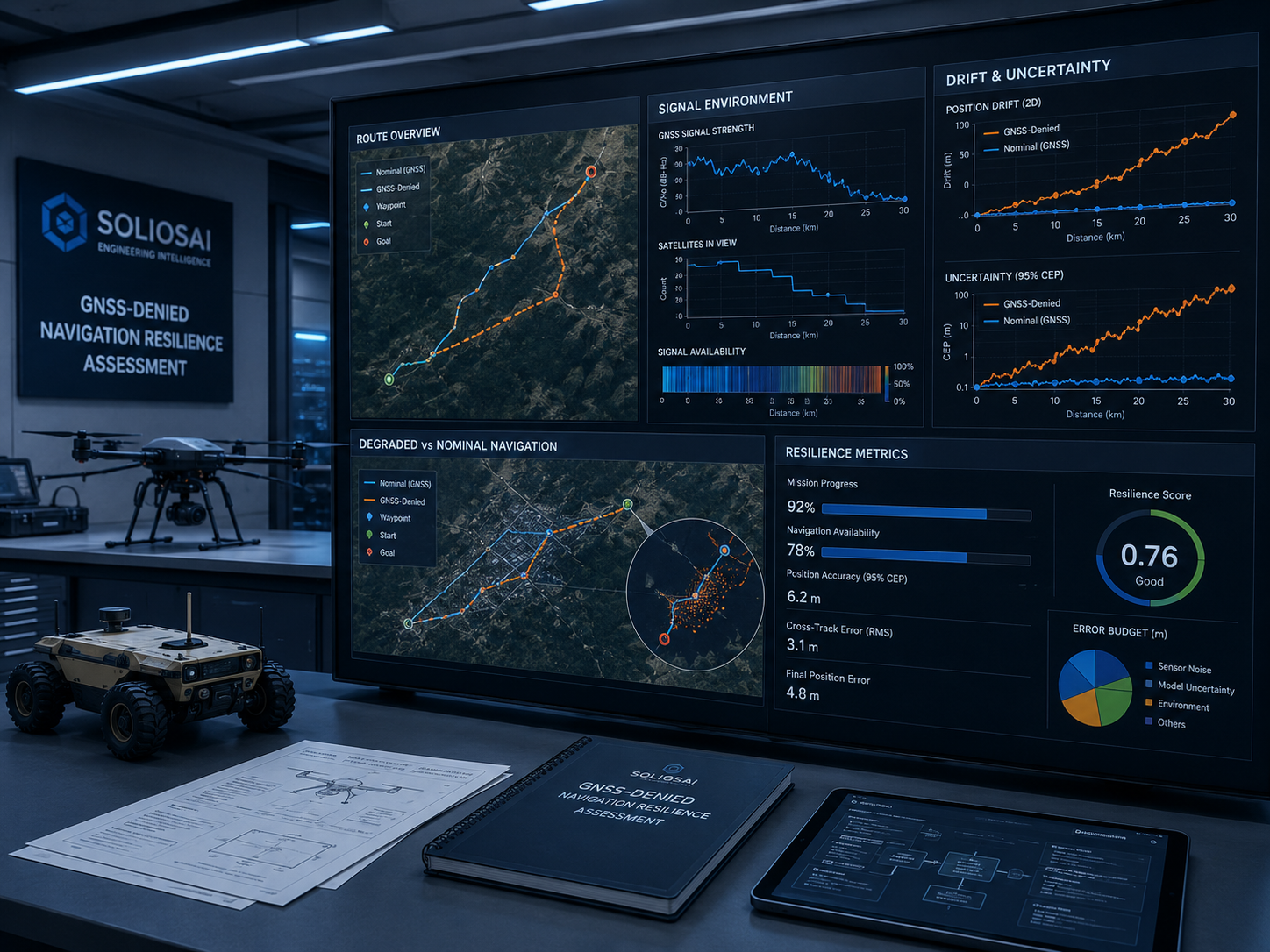
What This Assessment Can Cover
GNSS Degradation & Outage Scenarios
Assess how system behaviour changes when GNSS signal quality reduces, becomes unavailable, or produces unreliable positioning information.
Spoofing-Style Bias & Jamming-Style Disruption
Review scenarios where navigation inputs may become biased, unstable, interrupted, delayed, or inconsistent with expected system behaviour.
Sensor-Fusion Fallback Behaviour
Evaluate how the system relies on inertial, visual, barometric, lidar, radar, odometry, or other available sensor sources when GNSS is degraded.
Navigation Error & Uncertainty Growth
Review position drift, cross-track error, covariance growth, uncertainty behaviour, recovery response, and mission-performance impacts under degraded navigation conditions.
Typical Inputs and Outputs
Typical material that can support a GNSS-denied navigation resilience assessment may include:
Typical Inputs:
- GNSS outage or degradation scenarios
- Navigation plots or route data
- Sensor-fusion outputs
- Flight, mission, vehicle, or simulation logs
- Position error and drift metrics
- Mission assumptions or operational constraints
- Design review questions or system concerns
Typical Outputs:
- GNSS resilience findings summary
- Navigation drift and uncertainty observations
- Nominal versus degraded comparison
- Fallback behaviour and sensor-trust notes
- Risk-focused technical recommendations
- Plots, metrics, or visual evidence where applicable
- Review-ready technical summary
Data Handling & Engagement Boundaries
SoliosAI can begin with non-sensitive, non-classified, client-approved material such as problem statements, public system descriptions, sanitised logs, exported plots, simulation outputs, screenshots, design-review questions, or synthetic examples. For early GNSS-denied navigation resilience assessment work, SoliosAI can review approved material to identify likely navigation, GNSS, sensor-fusion, simulation, or fallback-behaviour risks before deeper engagement is considered. Sensitive, classified, confidential, or regulated information should not be shared until suitable engagement terms and data-handling arrangements are agreed.
Who This Is For
This service is suitable for engineering teams, autonomy developers, UAV and robotics integrators, maritime autonomy teams, mining technology groups, research organisations, navigation system developers, and technical decision-makers who need clearer evidence of navigation resilience under degraded, denied, biased, spoofing-style, jamming-style, or uncertain GNSS conditions.
Useful for:
UAV and robotics teams Mining autonomy and industrial technology groups Maritime autonomy and remote operations teams Navigation and sensor-fusion engineers Engineering teams preparing design reviews Research teams reviewing degraded navigation behaviour Teams investigating GNSS outage, drift, or fallback concerns
A GNSS-denied navigation resilience assessment can help teams understand how autonomous systems behave when positioning information becomes degraded, denied, biased, unavailable, or uncertain. SoliosAI can support GNSS resilience assessment, navigation drift review, sensor-fusion fallback analysis, uncertainty growth assessment, simulation evidence review, and practical technical recommendations for autonomous systems operating in complex or degraded navigation environments.
Need to Understand Navigation Risk Before the Next Review?
Discuss your GNSS resilience, navigation drift, degraded positioning, sensor-fusion fallback, simulation, or autonomy concern with SoliosAI.